2010 North American blizzard
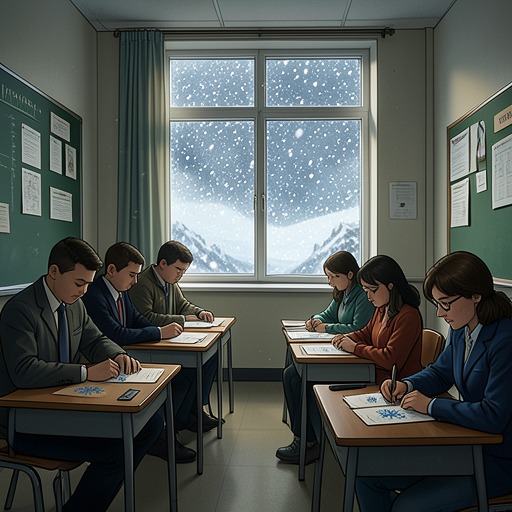
I'd Like to Apologize to Every Teacher I Ever HadThe 2010 North American blizzard is the winter storm that begins just after a classroom poetry contest has reached its final stage at Northeast High School. More than seventy inches of snow fall on Philadelphia over the following week and a half, breaking local records and forcing the school to close for a full week. In the narrative, the storm matters not merely as weather but as an external force that exposes how little time a pressured school has to lose: it suspends the contest, disrupts classroom continuity, and intensifies the teachers’ anxiety about covering the curriculum.
Causes and Background
The storm arrives at a moment of fragile academic momentum. On Friday, ten contestants remain to be heard on Monday, and the poetry competition has created a shared structure of anticipation in Tony Danza’s English class. The students have invested attention and performance in an activity that connects poetry to their own lives, while Tony Danza has used the contest to turn emotional risk into public participation. The approaching snow therefore interrupts more than a schedule; it interrupts a developing classroom ritual whose conclusion has been carefully deferred.
The blizzard also enters a school already governed by relentless institutional deadlines. Northeast High School is Philadelphia’s largest high school, with three stories, trailers, sports fields, a football stadium, a large cafeteria, cavernous gyms, and even its own Philadelphia police station. Its scale helps explain why delay has consequences beyond a single lesson. Teachers work within Small Learning Communities, handle extensive administrative obligations, and face pressure from Adequate Yearly Progress requirements. Because Northeast High School failed to meet its 2009 target, the 2010 Pennsylvania System of School Assessment carries unusually high stakes: test results can determine whether the school is treated as a failed institution and converted into a Renaissance School under new management. Against that background, a week without classes becomes a threat to the already compressed academic year.
What Happens
The storm begins by midnight after the Friday class, and the accumulating snow closes the school. Tony Danza watches the repeated whiteouts from the wall of glass he calls his “magic window” in Northern Liberties, Philadelphia, a vantage point that makes the city’s paralysis visible day after day. The scene contrasts his childhood delight in snow days with his adult responsibility. As a child, he had hoped for enough snow to cancel school, built igloos and forts, tunneled through drifts, played King of the Mountain, and joined snowball fights that ended with children running from angry drivers. In the present, the same phenomenon that once meant freedom now represents lost instructional time.
The closure lasts a full week, and the storm’s effects extend beyond the official days off. Tony Danza imagines students enjoying unstructured time rather than catching up on schoolwork, while teachers remain conscious of the curriculum clock. When the school finally reconvenes, the class cannot simply resume at its previous point. The remaining students recite their poems, but the scores are so close that Tony Danza asks contestants who performed before the storm to repeat their pieces. Al G refuses, saying he is not going to win and will keep the score he already received; Tony Danza does not force the issue.
The postponed contest eventually narrows to three finalists: Emmanuel, performing Edgar Allan Poe’s “Annabel Lee”; Janae, performing Maya Angelou’s “Still I Rise”; and Daniel, performing Sandra Tolson’s “He Sits Alone.” Their scores produce a three-way tie, requiring the principal to serve as final arbiter. Before the finalists perform, Tony Danza invites Al G to recite his poem for the principal despite his earlier refusal. Al G’s threatening look signals his resentment, but he accepts the offer and performs well. The blizzard thus delays the contest without erasing it; the class reconstructs its sequence, repeats earlier performances, and reaches a conclusion through altered conditions.
Consequences and Aftermath
The immediate consequence is a loss of momentum. Tony Danza describes the teachers’ fear that, after spending so much effort building engagement, they will return from the storm behind the point where they stopped. At minimum, the class must backtrack a day before moving forward. The storm turns time into a material problem: the school has only so many days to teach, assess, prepare students, and meet statewide testing demands, while the snowfall removes several of those days at once.
The interruption also changes the emotional texture of the poetry event. Repetition becomes necessary because the contest is no longer one uninterrupted progression from contestant to contestant. Al G’s resistance becomes part of the revised structure, and his eventual performance before the principal gives the delayed competition a moment of reluctant participation. The finalists’ close scores, the three-way tie, and the need for an ultimate decision make the storm’s aftermath feel less like a return to normal than a compressed attempt to recover a shared event.
Narrative Significance
The blizzard produces a sharp reversal in the meaning of a snow day. For the child Tony Danza, snow means freedom from school, homework, and adult authority; for the teacher Tony Danza, it means anxiety about students, schedules, and unfinished work. That contrast turns a familiar seasonal interruption into a measure of his changed position. He is no longer the child waiting for an announcement that school has been canceled. He is one of the adults responsible for restoring continuity after the announcement.
The storm also dramatizes the tension between human learning and bureaucratic measurement. Snow does not distinguish between a poetry recital, a routine lesson, or preparation for the Pennsylvania System of School Assessment, yet each lost day is absorbed into a system that demands progress on schedule. The narrative places the blizzard beside the school’s fear of failing Adequate Yearly Progress, revealing how weather can expose the vulnerability of an institution already operating under test-score pressure. What looks temporary—a week of closure—becomes consequential because the school’s time is treated as scarce, countable, and politically punishable.
Finally, the event extends the book’s recurring movement between personal memory and professional observation. Tony Danza’s recollection of childhood snow battles does not cancel his present concern; it makes the concern more poignant by showing the distance between past freedom and present obligation. The storm’s final effect is therefore double: it delays the students’ performances, but it also clarifies what teaching has come to mean for him. The snow stops the school, yet the work of education continues in the form of planning, worrying, repeating, and finding a way to finish what the weather interrupted.